Raising the Sails: Language Industry M&A Outlook for 2026
Who is moving forward with purpose, and who is still watching the weather?

Introduction: From Hesitation to Intent
In last year’s M&A outlook, we described the language industry as a group of people standing at the edge of the transaction waters. Many of them were still scanning the horizon, waiting for clarity, and hoping for more favorable conditions.
That image still holds, but the scene has changed.
As we move into 2026, C-suites, shareholders and boards are no longer watching nervously from dry land. Some bold companies have set sail and are committing direction, aligning resources, and moving forward with purpose, even amid uncertainty. Others remain at the harbour, still debating whether the tailwinds form perfect conditions.
This matters because 2026 will not reward hesitation, it will reward preparation and consistent execution.
The global M&A environment is stabilising, capital is becoming more selectively deployable, and AI has shifted decisively from hype to infrastructure. For the language industry, this creates a year defined less by volume and more by intentional consolidation, capability acquisition, and valuation realism.
This article looks ahead to what M&A in 2026 could look like for language service companies, technology providers, and investors, using lessons from 2025, real data and broader cross-industry M&A signals as guiding reference points.
The Macro Backdrop for 2026: Why activity is Moving Again
Across industries, dealmakers are entering 2026 with a clearer rulebook than they had twelve months ago.
Interest rates are no longer the dominant shock variable. Valuation expectations have recalibrated. Private equity remains capital-rich but far more disciplined. Most importantly, strategic buyers are no longer asking if AI changes their model, but where it belongs, which produces a specific type of M&A environment:
- Fewer speculative acquisitions.
- More capability-driven deals.
- Increased emphasis on integration readiness.
- Greater tolerance for smaller, well-defined transactions.
For the language industry, this aligns closely with what we observed through 2025. Buyers did not disappear, rather they became selective, value-focused, and highly pragmatic. We expect this to carry forward into 2026.
What 2025 Actually Taught Us
Looking back, several themes from 2025 proved durable rather than cyclical.
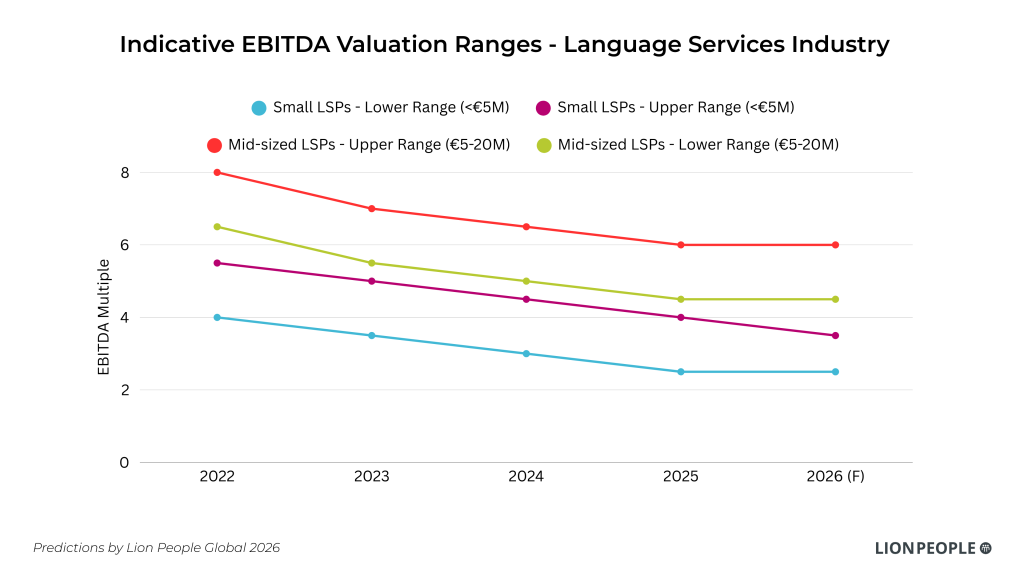
First, it was unequivocally a buyer’s market, particularly for LSP acquisitions below the 10 million range (whether USD or EUR). EBITDA multiples corrected sharply and stabilised. For many LSP sellers, this was uncomfortable but necessary.
Second, deep pocket buyers (mostly PE-backed) built pipelines with priority tiers to explore the following acquisition mandates:
- Tech disruptors that have proven themselves in the market and bring enterprise client portfolios with growth potential, a product /service offering and a tech stack that would take years and serious capital to build a tangible competitive advantage. These may be either well established and already profitable, or early ventures who have developed something truly amazing but lack the sales horsepower to make the leap.
- Traditional LSPs with solid books of business in sought-after verticals and geographies, whose revenues and profits are either experiencing flat growth or shrinking, provide the opportunity to enter new markets or expand market share, where there is clear ROI to uplift profitability by deploying the buyer’s technology suite.
- LSPs that have accelerated or already completed their AI-pivot in their corresponding verticals or niche, proven revenue recovery and new sales through additional offerings, and provide the opportunity to expand market share.
- Opportunistically, traditional LSPs in distress with attractive client portfolios and great talent that can easily be brought to a safe harbour.
- Established competitors of similar size with proven market credentials, technology, product/service offering, enterprise clients in order to increase market share and competitive advantage.
- Create true hybrids: for some, this means adding services to their known SaaS positioning, for others expanding from mainly project-based services to SaaS models, in order to win business and increase market share.
Third, the penny dropped for smaller players and some started to contemplate merging or creating joint ventures with friendly competitors who offer clear synergies and the opportunity to future-proof the business, defend revenue, increase profitability and build “2+2=5” value towards a future joint exit.
Fourth, typical deal structures still included components of cash at close, deferred payments (vendor notes), earnouts and equity (rollover and incentives), but risk tolerance narrowed and terms no longer included unrealistic growth expectations. Upfront cash is king for sellers, and buyers know this. However, a high cash component should be supported by strong asset security, and earnouts are rather based on the ability to fulfill realistic forecasts and steady profit improvement.
Fifth, not all portfolios were equal. Companies with sizable clients and specialization in interpreting (mainly healthcare), regulated industries with lower AI-adoption maturity to date, and growth industry clients, with recurring contract-based work or budgets were considered more resilient and consistently outperformed others in buyer interest.
Last but not least, AI exposure stopped being a buzzword and started becoming a valuation filter. Buyers were no longer impressed by AI claims. They wanted proof of how AI impacted outcomes; changed margin structure, client stickiness, or scalability.
These realities form the foundation for understanding what changes in 2026 and what does not.
M&A in the Language Industry in 2026: What Shifts, What Endures and What Deepens
1. Paths to scale are becoming a sniper activity
In 2026, buyers are less interested in buying volume for its own sake. Scale still matters, but only when it compounds capability.
We expect there will be continued demand for companies in 2026 that offer one or more of the following:
- Deep positioning in sought-after verticals, specializations and geographies. For example, regulated sectors are maintaining more resilience and remain slower to deploy AI technology for global content creation.
- Demonstrable AI-augmented delivery models with efficiencies that move the needle, or a clear pathway to implementing such models. This is not about replacing human services with AI. It is about proving that AI changes the economics of service delivery in a durable way.
- Strong orchestration, governance, or client-embedded workflows. Stickiness is a stand-out differentiator in the current market.
- Recurring revenue profiles, supported by MSA or agreed contracts.
- Pivoted and proven new business models (e.g. Subscription models), or pivot to new service types (e.g. data collection and annotation services).
- Technology based on a solid and proven AI backbone which offers a niche problem set solution and is ready for enterprise deployment.
- Service companies which have navigated dips in revenue and have consolidated profitability. Future projections should show a path to at least defending revenue position while continuously improving profitability.
We have seen cases of regulated industry companies getting above the quota number of LOIs compared to the market during 2025. This does not mean valuations are off the chart compared to the industry norm but more indicative that more executable LOIs are presented. We expect this to continue during 2026.
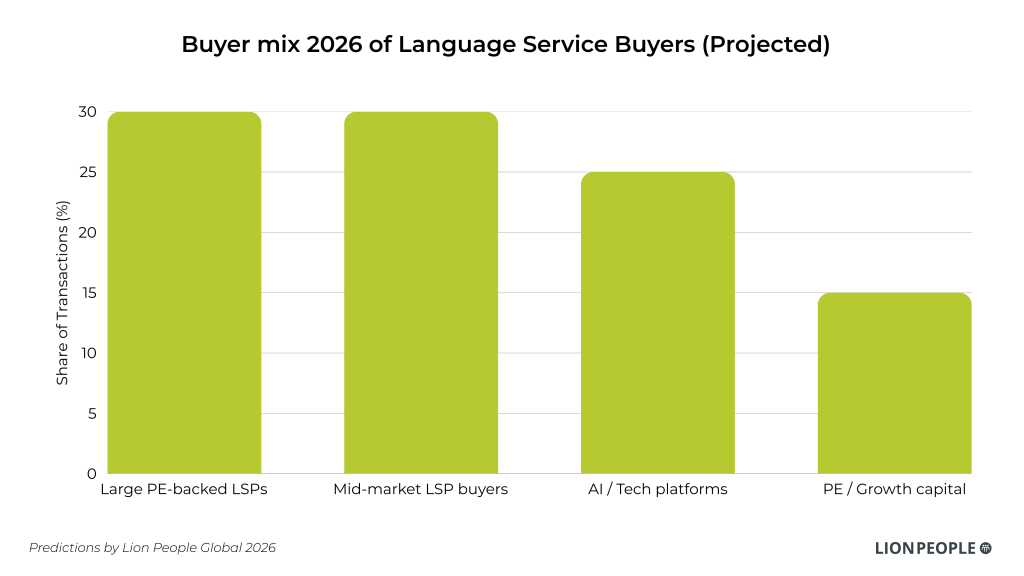
Private Equity (PE) has not lost interest in the language industry. However, there is a concern in some quarters about the eligibility of the industry in the next 3-5 years (to a degree AI-hype cycle driven).
In 2026, we expect PE interest will concentrate around:
- Platforms with clear buy-and-build logic.
- Businesses already demonstrating post-AI margin resilience.
- Management teams capable of executing operational transformation.
- Specific sector vertical platform focus which has proven itself.
Overall we expect fewer headline acquisitions and more mid-market platform expansion, particularly in the USD/EUR 5–25 million revenue range.
Continuation vehicles, mergers, minority investments, and structured growth capital will also play a greater role, especially where full exits are premature.
2. AI Company Valuations Will Split the Market Valuations
One of the most important developments in 2026 will be the valuation splitting between AI-native SaaS platforms, AI-augmented service businesses with a tech market positioning and AI-exposed but untransformed companies.
We expect three valuation profiles to coexist:
AI-native SaaS platforms
Valued on revenue multiples or strategic premiums, especially where proprietary data, workflow lock-in or platform extensibility exists, with proven business cases of delivering extraordinary business outcomes with surgical expert-in-the-loop applied. Attractive to buyers who see their products as a key addition to accelerate their path to market leadership under their purview.
- Early venture tech disruptors with truly outstanding products that have not yet surpassed the USD/EUR 1M revenue mark (and are not quite profitable yet) despite several funding rounds can expect EVs based on low double digit revenue multiples subject to deal terms with aggressive earnouts and/or equity rollovers.
- The revenue multiple range for late stage / scale up tech disruptors with a decent enterprise client portfolio, will be looking at single or double revenue multiples, depending on current portfolio and how their products rank in the competitive landscape today and in the next 2-3 years.
AI-augmented language service businesses with a tech positioning
Fully aware of the valuation premiums commanded by AI-native SaaS platforms, a growing cohort of up-and-coming and mid-market companies is pursuing an explicit take-off strategy: adopting an AI-first positioning built around proprietary, enterprise-grade platforms that orchestrate a broad spectrum of services.
This “hybrid” AI plus services model is designed to outcompete legacy language-technology vendors, undifferentiated language service providers, and narrowly focused disruptors alike. By combining platform leverage with service depth, these companies aim to materially expand market share and unlock 3× growth through scale, stronger client retention and revenue recurrence, improved operating leverage, and ultimately, significantly higher enterprise value.
Achieving this ambition requires substantial investment. As a result, these companies have secured-or are in the process of securing-backing from high-capacity investors, with a clear endgame: realizing single-digit revenue multiples or double-digit EBITDA multiples at exit over the medium to long term.
AI-exposed but largely untransformed companies
Facing continued valuation pressure due to perceived long-term defensibility risks. The value multiple story here has been in decline and we expect EV multiples to flatten or the decline to continue. Revenue decline or a blip has been the norm for most companies in this bracket. Most savvy buyers have recognised that there is still good value to be had from companies who have had top line decline but have taken actions which have already improved profitability markers, (GM, EBITDA). We expect this to continue in 2026.
- Sub-USD/EUR 5M revenue LSPs with EBITDA below 15% are generally seeing 2–3x EBITDA multiples.
- 4–5× EBITDA is now only achievable for LSP businesses with significant enterprise clients USD/EUR +7M in revenue and USD/EUR +1M (sustainable and improvable) EBITDA.
- High-performing companies of USD/EUR 10-25M in revenue or larger and +20% EBITDA may push for a slightly higher multiple, as long as they have a clear growth roadmap, resilient portfolio, differentiated tech or services.
To recap, in practical terms, this is not about AI “wiping out” value in the language industry, nor does AI development, acquisition or adoption automatically translate into higher valuations. As with any disruption S-curve, once the hype subsides, value accrues to those who deliver meaningful differentiation and business outcomes that clients are actually willing to pay for, underpinned by trusted governance, robust risk mitigation, and deep professional expertise.
3. The Rise of the Mid-Market Buyer (Language services)
One of the most under-appreciated trends heading into 2026 is the emergence of mid-market language service companies as repeat acquirers. These buyers are often faster, pragmatic, and backed by growth capital that bets on scale-ups. In many cases, they are also better positioned to integrate smaller acquisitions successfully. These buyers typically look to:
- Expand on their service offerings and GEO coverage (In particular pivoting to resilient service lines and capabilities).
- Acquire key enterprise portfolios which they can grow with their reach and support structures.
- Build a robust future-proofed platform.
- Have a clear growth path and supporting acquisitional roadmap backed by their financial backers (normally PE companies).
- Build relevance before reaching the next valuation tier.
These buyers are also agile and can typically act fast once a suitable target is identified. There are two sub-groups in the language industry.
- Businesses in the USD/EUR 5–15 million range, many who are acquiring for the first time, may acquire smaller companies (under USD/EUR 5 million) and may take additional time to ensure the deal fits well and do deeper diligence earlier. Personalities seeing eye to eye can be an important part of these deals passing the LOI stage and enabling successful due diligence and deal closure.
- A second group typically records USD/EUR 15-50 in revenues, have PE backing, are looking at M&A strategically to scale operations and grow by multiples. They look for M&A opportunities to fulfill an acquisition roadmap and can take on larger opportunities. Normally they have the ability to move quickly on acquisitions and aim to integrate organizations well while maintaining a good amount of nimbleness.
We expect these trends to accelerate during the year and we sense growing M&A activity will expand outside of these ranges as peer contagion sets in.
Risks and Frictions That Will Shape 2026
Despite improved clarity, 2026 is not friction-free.
Some key risks we feel will include:
- Continued valuation gaps between buyer logic and seller expectations.
- Integration fatigue among acquisitive platforms.
- Over-reliance on AI narratives without operational proof.
- Geopolitical and regulatory unpredictability in cross-border deals.
- Over subscription of unmatched sellers to buyers (many buyers tell us they saw this increase in 2025). Think twice before falling into a “selling encyclopedias door-to-door” dynamic.
- Being under-prepared in particular as deal complexity is increasing. This also includes not having the best industry advice and support when going to market.
The deals that succeed will be those grounded in operational logic rather than storytelling alone.
What Sellers Need to Do Now
For sellers, 2026 is not about waiting for a better market. It is about building optionality.
That means:
The language industry still harbours significant trapped value. Unlocking it requires honesty, preparation, and a willingness to evolve.
Conclusion: Set Sail Before Conditions Are Perfect
If 2025 was about waiting for certainty, 2026 is about executing on strategic intent.
The companies that succeed in M&A this year will not be the loudest or the largest. They will be the ones that set their course early and clearly, raise the sails, and navigate decisively toward their goals, ready for changing conditions and positioned to capture tailwinds to get ahead. And in a market defined by constant motion, that choice may be the one that matters most.